I preface this discussion with a few comments.
- The new model should be useful in CFD, and computationally at least as effective.
- Hence, the goal is not to extend the range of validity beyond that of the standard Navier-Stokes system.
- The new system models an ideal gas. That is, the molecules bounce elastically, with no intermolecular forces and with no vibrational and rotational modes that may store energy. The last assumption may be relaxed by including more refined gas laws, heat capacities etc.
- In classical mechanics, Newton’s 2nd law is often regarded as a first principle. For a particle, it certainly is, but for a collection of particles, conservation can be viewed as an equally fundamental property.
- The word diffusion to describes the transport caused by the random motions of the molecules.
- Conduction describes transfer of velocity and «velocity squared» due to collisions of molecules. Viscosity is therefore conduction of velocity.
In summary, the principles used to derive the model are:
- Particles have a finite size and mass.
- Conservation of mass, momentum and energy in an Eulerian volume element.
- Particles diffuse, i.e., the random component of velocity is a transport mechanism that is distinct from that of the mean velocity. (At the macroscopic level this well-known to be modelled by parabolic diffusion terms.)
- There is a transfer of macroscopic kinetic energy into macroscopic internal energy by collisions. (Conduction.)
Cloud of molecules to a macroscopic averages
To begin with, I consider the 3-D space filled with gas. I divide this space up into small non-overlapping Eulerian (fixed-in-space) boxes that cover the entire domain. The boxes have to be so small that they contain a sufficient number of gas molecules that meaningful averages of density, velocity, pressure, temperature, etc. may be calculated. (Not PDFs as in kinetic theory, just averages.)
In this way, I obtain a grid of macroscopic variables. From here one can take two different routes. One that interpolates the grid functions to differentiable functions on the entire domain, and then carry out the modelling in the continuous setting.
Or, stay on the volume elements. To set of the conservation balance laws, we have to calculate the flow in and out of each volume element. Since macroscopic variables are only known inside the volume elements, and not on their boundaries, we must approximate the fluxes across the volume element boundaries.
To do this, we make two second fundamental observations.
1) When a particle moves, it brings with it its mass, momentum and (kinetic) energy
2) The velocity of a particle can be divided into the average velocity of the volume elemet plus an (essentially) random component.
These two observations imply that there are two contributions to the transport across the volume interface. One associated with the average velocity and one with the random motion. The random motion is what is usually identified as diffusion. (See https://en.wikipedia.org/wiki/Diffusion_equation for a link between Brownian motion and the diffusion equation.) In view of the first observation above, all three conserved properties diffuse. That is, density, momentum and total energy. (At the macroscopic level, the particle kinetic energy is encoded in the total energy, i.e., the sum of the internal energy and the kinetic energy due to the averaged velocity.)
Furthermore, since the rate of flow of particles is the same, irrespective which conserved property that is considered, all diffuse at the same rate.
This gives the transport component to the flux.
The next contribution to the conservation balance is pressure, which change the momentum, and carry out work which affects the energy equation. (The arguments is exactly the same as the textbook derivation of the inviscid Euler equations in an Eulerian frame.)
Relaxation of internal energy.
In the original model, I only accounted for diffusion across the continuum box boundary. (The nu terms.) However, both from experiments and kinetic theory, it is known that heat conducts at a higer rate than predicted by diffusion. Thus, there must also be a conductive mechanism transporting temperature (or heat since conduction does not involve mass transport.) This correction was then added to the model. (The kappa_T term.) There is only one way this can be done without violating entropy principles. What the term models is collisions within volume element that transfer the «orderly» kinetic energy to the «disorderly» internal energy without changing the total energy.
The new model: From discrete to continuous model
In this modelling route, we are still in the discrete setting on the volume elements. The model looks very much like a finite volume scheme for all the volume elements. Of course, there are other constraints that the model must satisfy, like the entropy inequality and sufficiently strong bounds on the variables themselves. That is, the discrete model must be well-posed in an appropriate sense.
By interpolating the grid solution functions to smooth functions on the entire domain, it is readily seen that they (approximately) satisfy what I have termed the diffusive compressible Euler model, takes the form:
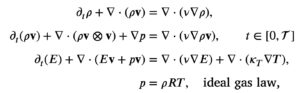
where nu in the right-hand side is the diffusion coefficient and kappa_T is a temperature diffusion coefficient.
Note the reverse approximations. Our model is the discrete one, and the PDE is the approximation. Our interpolated solutions satisfy the continuous model to within order of the volume elements size. Thus., the continuous model has no meaning below this length scale.
Next, we observe that by using the continuous in place of the discrete, we tacitly assume that solutions to the continuous model approximately satisfy the discrete model. For this to hold, the continuous model too must be well-posed.
In comparison with the standard Navier-Stokes moel, the dcE model has a much simpler mathematical structure and its fluxes are much cheaper to compute numerically.
From kinetic theory, it is straightforward to deduce that nu=mu/rho. This ensures that Blasius boundary layers are recovered. It is not surprising that its value is related to the viscosity coefficient since both model the effect of random motions in a gas. However, I stress that nu is not a viscosity coefficient. The dcE model in its presemt fpr, does not contain any constitutive law for viscosity.
Furthermore, kappa_T is not the same as kappa appearing in the Navier-Stokes equations. The nu*nabla E term consists heat diffusion and the kappa_T accounts for the discrepancy between that term and the kappa-term in the Navier-Stokes equations. The dcE model distinguishes between conduction and diffusion.
Today, this model has been validated for a wide range of aerodynamic (and some other) cases, where its solutions have turned out to be indistinguishable from those of the Navier-Stokes equations. In addition, weak solutions, which is a practically useful notion of solutions, have been proven to exist without any a priori assumptions. The proof utilises a convergent numerical scheme meaning that there is a practically usable scheme available that, with mathematical certainty, approximates solutions.
As already mentioned, the simplicity of the system makes it easier to code and it runs faster. Since it contains diffusive terms in all equations, it relaxes much faster to steady state. Boundary conditions no longer require complicated workarounds. There are no energy or entropy gradients through an adiabatic wall. Multi-component fluids can now be modelled by the generally accepted Fick’s law of diffusion. The equations do not allow density, temperature or pressure to become negative. Diffusion and conduction, not convection, relaxes solutions at microscopic scales.
I end this summary of the derivation by pointing to Occam’s razor (https://www.britannica.com/topic/Occams-razor): «Of two competing theories, the simpler explanation of an entity is to be preferred.»
Possible extensions of the model
The ideal gas assumption is, under not too extreme conditions, accurate for monatomic gases without any intermolecular forces. The molecules of air are diatomic, which already is a step away from the ideal gas assumption. Nevertheless, for many purposes the ideal gas assumption yields accurate results also for air.
Di- or multiatomic gases allow for energy to be stored within the molecules. This changes the thermodynamic coefficients of the gas and should be readily incorporated in the current dcE model.
Multiatomic may also induce forces between molecules. That will add friction to the system, which is not modelled in the current dcE model. However, just like conduction can be added, a friction force can act on the volume element boundary and thereby affect the momentum and energy equation. Mathematically, that would imply that a stress tensor is added. Obviously, it will not be the stress tensor if the classical Navier-Stokes equations since that models the velocity dispersion due to diffusive motions in the gas, and also expansion and contraction which does not appear in an Eulerian frame. The stress force due to intermolecular forces could presumably be modelled as a Newtonian stress force. However, only the components acting in the direction of the momentum components must be added.
To deduce the intermolecular friction coefficient, experiments must be carried out that establishes the relation between diffusion and intermolecular friction.
Finally, we remark that if the gas becomes denser and denser, the main dispersive mechanism may gradually shift from being diffusive to conductive. This however is at least partially captured in the current model since as density increases, the mass diffusion decreases and velocity gradients play an increasing role in the dispersion of momentum and energy.